Key takeaways
- Look at live websites in the portfolio, not pictures.
- The domain, hosting and access must be in your name.
- Stages, timeline and scope — in writing before payment.
- Compare quotes against the same scope of work.
To choose a web developer, ask 12 questions on the first call: about portfolio, stages, timeline, ownership, admin panel, SEO and support. A good contractor answers specifically, not in general terms.
Questions about experience
- Show me 3–5 live sites similar to my task. Not mockups — working sites. Open them on your phone and check the speed. My work is in the portfolio.
- Who exactly will build my site? Agencies may hand it to a junior. It’s better when you talk directly to the person doing the work.
- Can I talk to a previous client? Reviews with names, companies and links are worth more than anonymous ones.
Questions about process and timeline
- What are the stages and what do I approve at each?
- How many revisions are included?
- What is the real timeline and what affects it? An honest answer includes your part: copy, photos, approvals.
- How will we communicate and how fast do you reply?
Questions about money and ownership
- What exactly is included in the price? Design, mobile version, admin panel, forms, SEO setup, analytics, a guide.
- Whose name are the domain and hosting in? The right answer is yours.
- Will you hand over all access and files?
Questions about the result
- Can I edit copy and prices myself? Ask to see the admin panel of a finished site.
- What happens after launch? Bug-fix guarantee, support, updates, cost of edits.
Dmytro’s take. The best test is asking for a short site structure after the first call. If the developer asks about your clients, competitors and traffic sources, they think about sales. If they talk only about design and animations, the site will be pretty — but not necessarily selling.
Red flags
- A price before the developer understood the task.
- A portfolio of pictures or sites that no longer work.
- Offering to register the domain and hosting “in their name, it’s easier”.
- No written scope and stages.
- 100% upfront with no guarantees.
- Promises of “#1 in Google in a month”.
What the contract or offer should include
- Scope: pages, features and integrations included in the price.
- Stages, timelines and what’s needed from you at each.
- Price, payment terms and what happens to the deposit if the project stops.
- Number of revisions and how extra ones are billed.
- Transfer of rights, access and source files after payment.
- A warranty period for bug fixes.
How to compare quotes
| Compare | Look at |
|---|---|
| Price | Fixed or “from”, possible extras |
| Timeline | By stage, including your approvals |
| Scope | Design, mobile, admin, SEO, analytics |
| Ownership | Domain, hosting, access — yours |
| After launch | Guarantee, support, cost of edits |
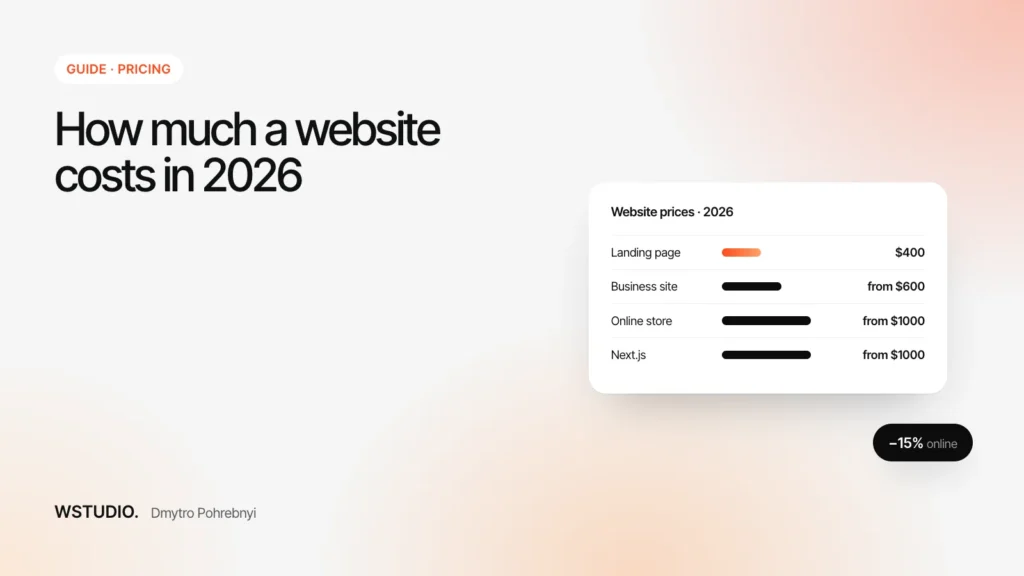
Price benchmarks — in how much a website costs. Want a structure and an exact estimate for your task? Message me — it’s free.